
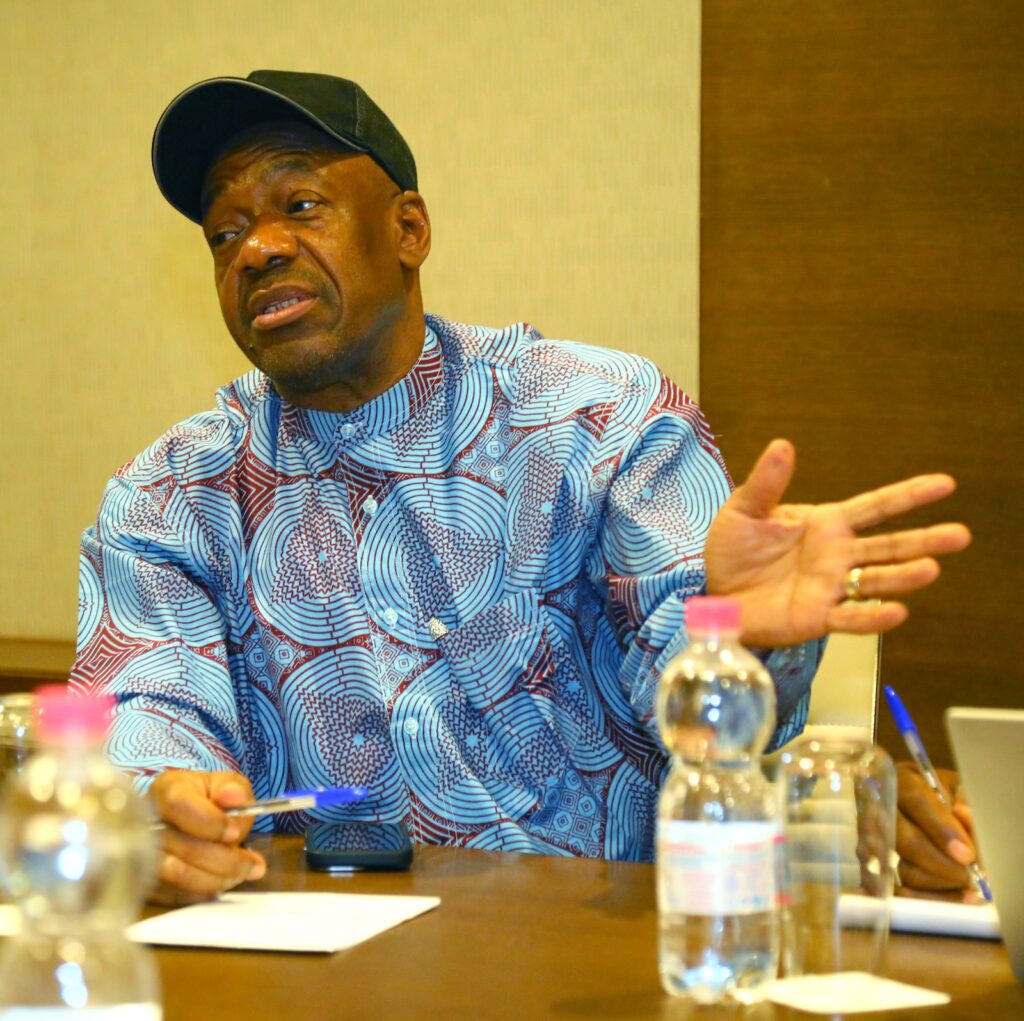
by Professor Samba O Sow, Co-chair of the REACH Network and Director General of the Center for Vaccine Development – Mali
At this year’s World Health Assembly (WHA 79), the global health community took an important step towards reforming the global health architecture.
WHO’s reform paper says many of the right things when it calls for a system that is more country-led, more coherent, more inclusive, and more responsive to the needs of countries and communities. It acknowledges fragmentation, duplication, power imbalances, and the need to shift from globally-driven programmes towards country-led and regionally-supported approaches.
Health Policy Watch also captured the central tension well: everyone now speaks of bottom-up reform, but the question of who really shapes such a process is still very much open.
Honesty
I welcome this conversation. But I also believe we need to be much more honest about what bottom-up reform would actually require.
Too often, priorities in global health are still shaped far from the places where the hardest work is done. They are discussed in clean, well-organized rooms by people who know the literature, who may have studied communities carefully, even compassionately, but who have not had to work among them, in the conditions that define daily life.
That distinction is important.
There is a profound difference between analysing vulnerability and working with the operational realities of insecurity, distrust, poor roads, weak systems, fragile politics, and the daily task of earning legitimacy, one conversation at a time.

Strategy in practice
This is not an abstract concern for me.
I often feel pressure to spend less time in the field and more time in air-conditioned offices, travelling to meetings, attending dinners, and joining Zoom calls.
I understand why.
That is where institutional relationships are managed, and where it is assumed that “strategy” will be developed.
In practice, this means spending less time in the places where trust is built, where rumours can be challenged before they harden into resistance. In the communities who decide whether you are serious, whether you can be believed, and whether your programme belongs to them or to somebody else; the only place where you can really understand whether an “integrated platform” is functioning or whether it is simply another elegant concept that evaporates on contact with reality.
This is why I believe so deeply in REACH.
Beyond purely technical interventions
For me, REACH is not only a technical intervention. It is an attempt to build something that global health talks about constantly but rarely succeeds in delivering fully: a genuinely country-led, equity-focused platform rooted in real need, real systems, and real accountability.
The REACH Network exists to bring together programme managers, researchers, policymakers, health officials, implementers, and beneficiaries so that the next steps for scale-up are shaped by countries themselves. Its principles are rooted in best practice, country leadership, and the exchange of knowledge between researchers and policy-makers.
The areas of focus are meant to be driven by need within participating countries, not by the preferences of outside actors.
That is why REACH matters to me so much – because it is an attempt to do something which is incredibly difficult to achieve. It tries to connect evidence, public health action, and country decision-making.
Built around reducing child mortality in high-mortality settings through the safe, equitable, and effective delivery of azithromycin, it also engages wider issues of antimicrobial resistance (AMR), mortality surveillance, health economics, and policy development.
In other words, it is not just about reaching children with a product. It is about building the systems, the evidence, and the legitimacy that allow countries to decide how to protect their most vulnerable children in a way that can endure.
Building systems to last
And this is where the conversation about reform of the global health architecture becomes real.
If it is truly to become more country-led, then it must learn from platforms like REACH, because REACH shows what country ownership actually looks like in practice: governments and national institutions setting direction; evidence being generated in the field, not imported from outside; technical questions – about AMR, mortality, and delivery – being debated collectively rather than imposed; and implementation being adapted to context rather than forced through a single template.
That is harder work than many people realise. But it is the kind of work that contributes to building systems that can last.
And in fragile and insecure settings, this matters even more.
Many global discussions still have a shallow understanding of what it actually takes to create high-quality, integrated programmes for the people who need them most.
We speak readily of equitable healthcare, resilient systems, community-driven delivery, and sustainability.
In fragile settings, however, none of these things will come about because they were promised in a strategy document. They come about because someone stayed long enough to understand local power dynamics, to build confidence, to train people properly, to adapt to insecurity, to answer rumours patiently, and to work with existing systems rather than bypass them.
We mustn’t underestimate the nature of the reforms required.
I worry that discussions about global reform still underestimate these questions. Country ownership may be spoken of while the real power to define priorities is retained elsewhere.
We speak of equity while continuing to privilege those with easier access to the room. We speak of integration, but still fund vertical top-down programmes.
And we speak of community trust without fully understanding how quickly that trust can be lost, and how much work is needed then to win it back.
The truth is that the rhetoric around equitable, quality healthcare will only be given concrete reality if we are prepared to change how we work. That means allowing countries to own decision-making, not just implement decisions made elsewhere.
It means proper, long-standing investment in capacity.
And it means funding national and regional institutions so that they can generate evidence, manage trade-offs, and build platforms that won’t disappear when a grant cycle ends.
We must recognise too that “success” will look different in different places, and that the most difficult settings will often require the most adaptive approaches, not the most rigid ones.
REACH puts a clear vision into practice
REACH tries to put all this into practice. It attempts to reach the most vulnerable children in high-mortality settings through a country-led model that is evidence-driven, equity-focused, and serious about stewardship. That means going beyond the “single intervention” paradigm, to try and build a platform, to support better decision-making, better delivery, and – over time – a holistic vision for integrated child survival. It is also honest about the complexity this entails, while still insisting that progress is possible.
When we speak of reforming the global health architecture, then, I would ask a very simple question:
Are we as a global community really ready for what true bottom-up reform would mean?
A true bottom-up approach should not be simply a nicer form of consultation. It would require those with power to accept that countries may define priorities differently.
It would require global institutions to support national leadership rather than seek to put themselves in its place and donors to fund capacity and process, not just visible outputs.
And it would require giving less prominence to the air-conditioned meeting room, so that our work remains grounded in the field, where all our lofty principles must be challenged every day.
That is the choice, as I see it.
We can succeed!
If bottom-up reform is to be a going concern, then we must change our standpoint, so that we encounter and hear the different voices, who will encourage us to build systems differently. If we fail to do this, we risk spending another generation in the service of elegant promises whose concrete benefits communities will never fully feel.
We can do better – I believe this passionately. But we must learn the lessons and look to platforms like REACH, a shining example of what that future could look like if we are really serious about building global health from the ground up.
Professor Samba Ousmane Sow is Director-General of the Center for Vaccine Development – Mali. He served as Minister of Health and Social Development of the Republic of Mali between 2017 and 2019.
He co-chairs the REACH Network, alongside Dr Muhammad Ali Pate, Coordinating Minister of Health and Social Welfare of the Federal Republic of Nigeria.
